Water Stain on Ceiling? When a Patch Is Enough and When to Replace the Drywall (2026)
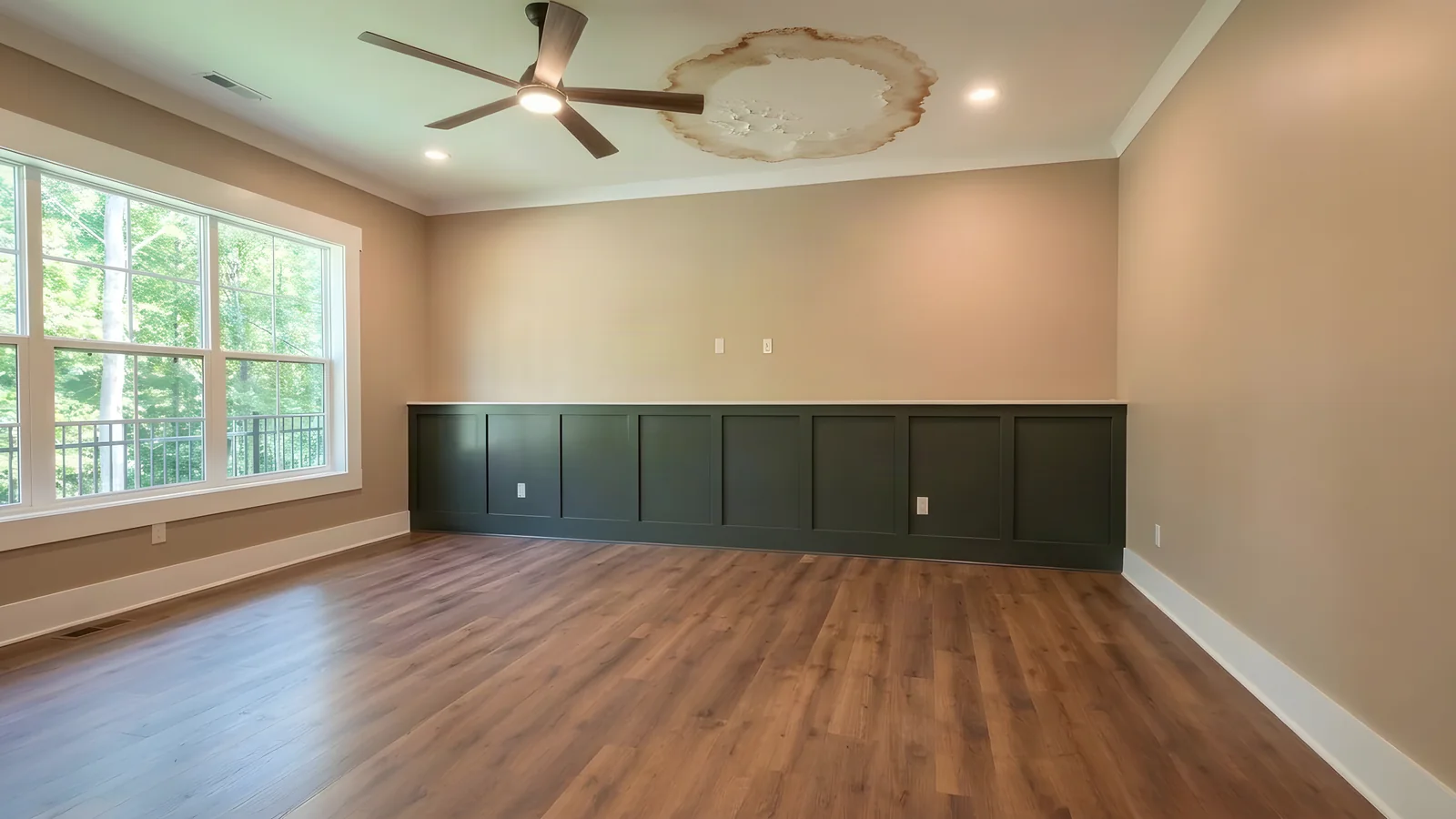
If the water stain on your ceiling is dry, firm and flat, you seal it with a stain-blocking primer and paint it. If the drywall is soft, sagging or smells musty, that section gets cut out and replaced, after the source of the water is fixed.
That’s the whole answer in two lines. The rest of this guide helps you figure out which case you have, what each repair costs, and where you can save without paying for the same ceiling twice.
What a Water Stain on Your Ceiling Is Telling You
A brown ring on the ceiling means water reached the drywall at some point. The question is whether it’s still coming. A few clues tell you a lot before anyone climbs a ladder.
- Dark, damp edges: the water is recent or still active.
- Dry, tea-colored rings: often an old leak that dried in place.
- Several rings inside each other: the leak came back more than once.
- A stain near an exterior wall or below a bathroom: points to the roof or the bathroom above.
A simple test: draw a light pencil line around the edge of the stain. Check it after the next heavy rain or after a week of normal use upstairs. If the stain crosses the line, the leak is active.
Water stain on ceiling but no leak?
This is one of the most common questions, and it usually means the water shows up only some of the time. The usual suspects:
- Condensation from the heating and cooling system in the attic, like a clogged drain line, an overflowing pan or sweating ducts. It tends to show in summer.
- A roof leak that only appears in wind-driven rain, around flashing, vents or a chimney.
- A bathroom upstairs: worn caulk around the tub or shower, or a toilet seal that leaks a little with every flush.
- An old leak that was fixed but never sealed, so the stain stayed.
If the stain is new and you can’t find a source, have the roof or the system above it checked before you repair anything.
Fix the Source First: Who to Call Before You Touch the Ceiling
iFIXX repairs the ceiling. We don’t fix the roof, the pipe or the heating and cooling system that let the water through. That work belongs to the trade that handles that system, and it comes first.
- Roof, flashing or gutters: a roofer.
- Supply line, drain or toilet upstairs: the trade that handles the pipe.
- Attic unit, drain line or ducts: the trade that handles the heating and cooling system.
Patching a ceiling over a live leak just puts the same stain back in a few weeks. That’s the most expensive way to fix a ceiling, because you pay for it twice.
If the water is still coming in right now, start with our guide on what to do when you have water damage at home and the first 24 hours after a water leak. This article picks up once the water is stopped.
The 3 Levels of Water-Damaged Ceiling Repair
Once the source is fixed and the area is dry, every water stain on a ceiling falls into one of three repairs. Here they are side by side.
| Level | What it is | When it applies | National cost | Time |
|---|---|---|---|---|
| 1. Seal and paint | Stain-blocking primer, then ceiling paint | Dry, firm, flat drywall; stain not growing; no smell | No separate national price; it’s the smallest job. Free estimate from photos | Usually one visit |
| 2. Patch | Cut out the soft spot, add backing, new drywall, tape, compound, texture, primer and paint | A small soft area, bubbling paint or loose tape, with firm drywall around it | $100 to $600 for a ceiling patch (Fixr) | 1 to 2 days, for drying between coats |
| 3. Replace the section | Remove the damaged sheet, check insulation and framing, hang new drywall and finish | Sagging, crumbling, mold, musty smell or damage in several spots | $200 to $1,500 for a water-damaged ceiling; $250 to $1,000 for a sagging one (Fixr) | 2 to 3 days with texture and paint |
These are national ranges from Fixr’s ceiling repair guide, updated January 2025. Fixr also puts replacing an entire ceiling at $1,000 to $3,000, which is rarely what a single leak needs.
Not sure which level you’re looking at? Text photos of the stain to (980) 391-6833 and a person gives you a price the same business day. You can also send them through our contact page or see what our drywall and ceiling repair in South Charlotte covers.
5 Checks You Can Do Yourself
You don’t need a moisture meter to narrow it down. With the source fixed and a few dry days behind you, look at these five things.
- Firmness. Press gently next to the stain with your fingertips. Firm drywall is a Level 1 candidate. If it gives or feels spongy, it needs to come out.
- Sagging. Hold a straight board or a level flat against the ceiling across the stain. Any gap in the middle means the drywall lost its grip.
- Smell. Stand under the stain and breathe in. A musty smell usually means mold, and moldy drywall gets replaced.
- Visible mold. Look for gray, green or black spots on or around the stain. Measure the area.
- Growth. Use the pencil line from above. A stain that keeps growing means the source is not fixed yet.
Why sagging drywall can’t be pushed back up
Once a ceiling sags from water, it stays weak even after it dries. The screws lose their hold and the gypsum softens. PuroClean’s restoration guide puts it plainly: drywall that is sagging or bulging “will never be structurally sound again”.
If you see the ceiling bulging or hear water above it, keep everyone out of the room and away from the spot. A wet sheet of drywall is heavy.
When mold changes the job
The EPA’s mold guide says wet areas should be dried within 24 to 48 hours to prevent mold. If mold covers less than about 10 square feet, you can often clean it yourself. If it covers more than 10 square feet, the EPA sends you to its guidance for professional cleanup.
The EPA is also clear on two points: don’t paint over mold, and porous materials that get moldy may have to be thrown away. That’s why a moldy section of ceiling drywall gets cut out, never covered.
What It Costs to Fix a Water-Stained Ceiling
The honest answer to “how much does it cost” is that it depends on the level, and the level depends on the five checks above. Here’s what moves the price within each one.
- Size of the damaged area. A 2-foot patch and a full 4-by-8 sheet are very different jobs.
- Texture. Smooth, orange peel, knockdown and popcorn each take a different amount of work to match.
- Paint. Painting the repair only, or the whole ceiling so the color matches.
- Height and access. Vaulted ceilings and stairwells need more time and equipment.
- What’s above. Wet insulation has to come out before new drywall goes up.
If you got a quote that seems high, ask what level it’s for. Two quotes for “the same ceiling” often describe different repairs: one seals and paints, the other replaces a section.
Old popcorn ceiling? Don’t scrape it yet
If the stain is on an old popcorn ceiling, be careful before anyone scrapes or cuts it. The EPA’s asbestos advice is direct: if in doubt, treat the material as if it contains asbestos and leave it alone, and don’t take samples yourself. Have it tested by a professional first.
Why the Stain Comes Back After You Paint
If you’ve painted over a stain and watched it come back, you’re not alone. There are two reasons it happens, and both are avoidable.
The leak is still active. No primer stops water that keeps coming in. Fix the source, let it dry, then paint.
The wrong primer was used. The brown in a water stain is a dye that dissolves in water. According to Composite Paint’s guide on blocking ceiling stains, water-based ceiling paint and water-based primers re-dissolve it and pull it back to the surface.
A shellac-based or oil-based stain-blocking primer seals it in. One coat over the stain, then ceiling paint over the whole area.
Even with the right primer, a patch of fresh paint on an old ceiling rarely matches in color and sheen. Light hits a ceiling at an angle and shows every difference. Often the cleanest result is painting the whole ceiling, which our interior painting service handles in the same visit.
Where to Save and Where Not to Cut Corners
If you’re going to save somewhere, save here:
- Don’t replace what only needs sealing. A dry, firm stain is a primer and paint job. Nobody should sell you new drywall for it.
- Replace the section, not the ceiling. Fixr notes you don’t necessarily have to replace the entire ceiling after a leak. Damaged sections, yes.
- Batch your repairs. If you have a nail pop in the hall and a crack over a door, fix them in the same visit as the ceiling.
- Send photos first. For a small repair, photos by text often get you a price without waiting for a visit.
This is the part we don’t cut corners on:
- Drying the cavity completely before the ceiling is closed. Wet insulation or framing above a new patch brings back the stain and the smell.
- Stain-blocking primer under the paint, every time.
- Cutting back to solid drywall instead of spreading compound over a soft spot. Compound over wet gypsum cracks and falls.
- Checking the insulation above the ceiling while it’s open. Damp insulation gets replaced.
- Matching the texture. On a ceiling, a patch with the wrong texture reads as a shadow from across the room.
We started in 2019 fixing small things around the house, and most of our clients called us first for something small. That’s why we treat a ceiling patch with the same care as a remodel: cut clean, dried, sealed, textured and painted.
Will Insurance Pay for the Ceiling?
It depends on your policy and on what caused the leak. Before any repair, call your agent and ask how your policy treats this kind of water damage.
Either way, take clear photos of the stain, the source and any damaged belongings before the repair starts. Keep the invoice for the source repair too. That paper trail helps whichever way the claim goes.
Get a Price for Your Ceiling
A water stain on your ceiling is usually a smaller job than it looks, as long as the source is fixed and the cavity is dry. The fastest way to know your level and your price is to show it to someone who repairs ceilings.
Text photos of the stain to (980) 391-6833 with a note on which room it’s in and what’s above it. A person gives you a price the same business day. The estimate is free, and iFIXX is locally owned and insured.
You can also request your estimate online or read more about our ceiling and drywall repair. We work in Ballantyne, Pineville, Matthews, Mint Hill, Waxhaw, Weddington and across South Charlotte.
Water Stain on Your Ceiling: Common Questions
Can I just paint over a water stain on the ceiling?
Only if the leak is fixed, the drywall is dry and firm, and you seal the stain first with a shellac or oil-based primer. The brown mark dissolves in water, so regular ceiling paint or a water-based primer lets it bleed back through.
Why do I have a water stain on my ceiling but no leak?
The water may come and go. Common causes are condensation from the heating and cooling system in the attic, a roof leak that only shows in wind-driven rain, a shower or toilet seal upstairs, or an old leak that already dried.
Does the ceiling need to be replaced after a leak?
Usually not the whole ceiling. According to Fixr, damaged sections most likely need replacing, but not the entire ceiling. Dry, firm drywall gets sealed and painted. Soft or sagging drywall gets cut out and replaced.
How much does it cost to fix a water-stained ceiling?
Fixr puts water-damaged ceiling repair at $200 to $1,500 nationally and a ceiling patch at $100 to $600. Sealing and painting a dry stain is the smallest job. With iFIXX, the estimate is free and you get the price before any work starts.
Is a water stain on the ceiling dangerous or a sign of mold?
A dry, old stain usually is not. A stain that stays damp, smells musty or sags is. The EPA says wet areas should dry within 24 to 48 hours to prevent mold. If the ceiling bulges, keep everyone out from under it.
How long does a water-damaged ceiling repair take?
Sealing and painting a dry stain usually takes one visit. A patch takes 1 to 2 days because each coat of compound has to dry. Replacing a full section takes 2 to 3 days with texture and paint.
How long should a wet ceiling dry before repair?
Until the drywall and the space above it are completely dry and firm. The EPA's window to prevent mold is 24 to 48 hours of drying. Closing the ceiling over wet insulation or framing is how the stain and the smell come back.
Who should I call for a water stain on my ceiling?
First the trade that handles the source: a roofer for the roof, or the trade that handles the pipe or the heating and cooling system. Once the water is stopped and dry, call a drywall contractor like iFIXX to repair the ceiling.
Need Help With Your Home?
Our team of experts is ready to help with any repair or remodeling project.
Our Services
Need help with a project? We offer expert repair and remodeling services throughout Charlotte.