The Best Kitchen Countertops for the Money in Charlotte (2026): The Taj Mahal Look Without the Taj Mahal Price
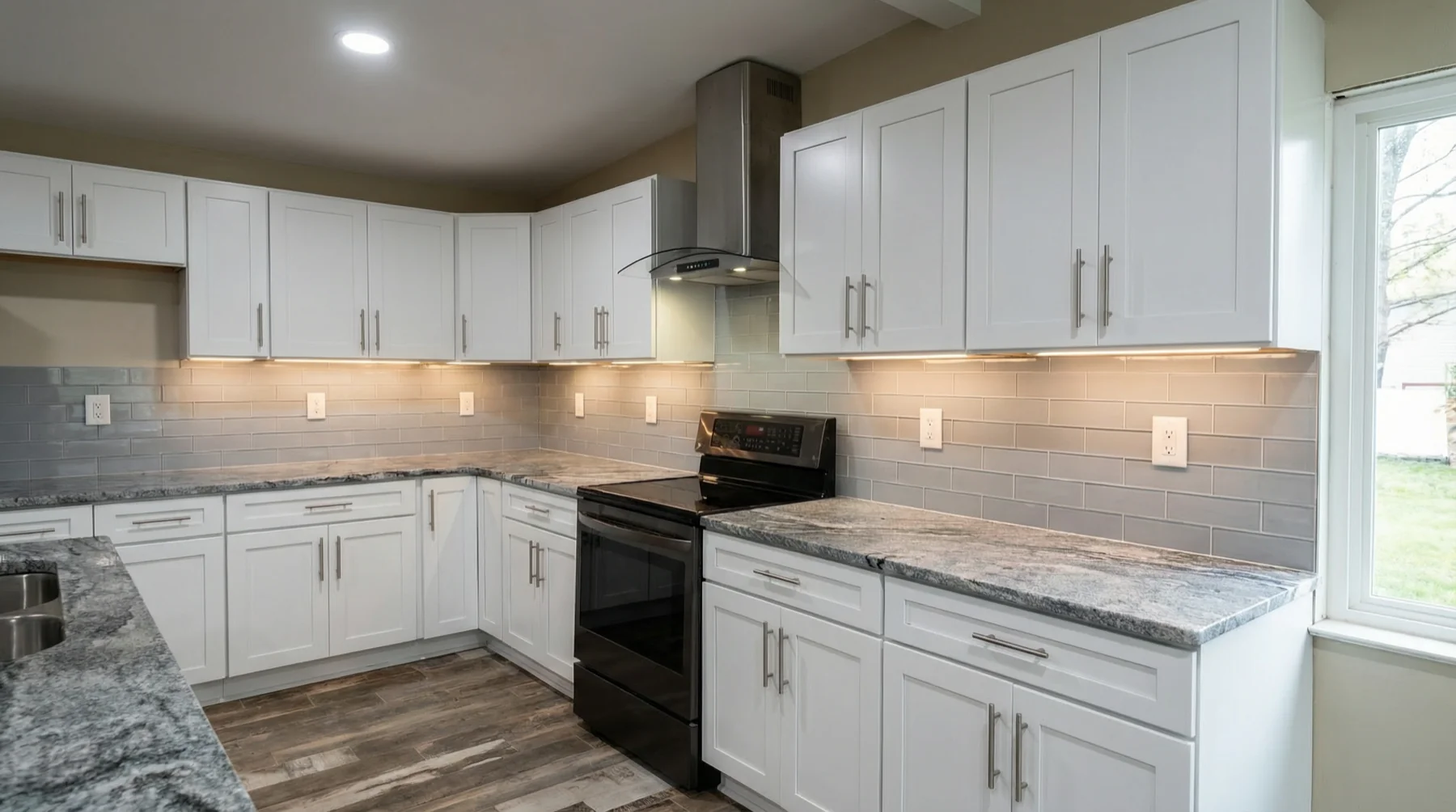
The best countertop for the money in Charlotte is tier 1 granite, at about $45 to $65 per square foot installed. It gives you the most stone for what you pay.
If the look you want is Taj Mahal quartzite, the countertop most people ask for, plan on about $70 to $130 per square foot installed for quartzite, with Taj Mahal near the top.
You can get a very similar look for less with Taj-style quartz, porcelain or a lesser-known quartzite.
We remodel kitchens. We don’t sell stone and we don’t run a showroom, so we look at the countertop as one piece of the whole job: the cabinets under it, the sink in it and the schedule around it.
Below you’ll find Charlotte prices, what makes Taj Mahal special, four ways to get the look for less, the 5 materials worth your money and a 40 square foot budget.
Charlotte countertop prices at a glance
| Material | Installed price per sq ft | Lifespan | Upkeep | Best for |
|---|---|---|---|---|
| Quartzite (Taj Mahal and similar) | $70 to $130 | Decades with sealing | Seal every 1 to 2 years | The premium look in natural stone |
| Tier 1 granite | $45 to $65 | 30+ years | Seal about once a year, or when the water test says so | The most stone for your money |
| Entry-level quartz | $55 to $80 | 25+ years | No sealing; trivets for hot pans | Low upkeep and an even color |
| Modern laminate | $15 to $50 | 10 to 15 years | Low, but damage usually means replacing it | Refreshes, rentals, the tightest budgets |
| Butcher block | $55 to $110 | 20+ years with care | Oil every few months; keep water off | Islands and work zones |
| Solid surface | $50 to $100 | 20 to 30 years | Light scratches and scorch marks sand out | Long runs with near-invisible seams |
Stone prices are what Charlotte-area fabricators charge in fall 2026 for 3 cm slabs with a standard edge. Laminate, butcher block and solid surface come from Block Renovation’s July 2026 guide to affordable countertops.
National guides like Fixr’s 2026 countertop cost data run wider, granite up to $150 and quartz past $200, since they cover premium slabs and every market.
Planning new countertops as part of a kitchen remodel? We check the cabinets under them, set the order of every trade and tell you where your money goes furthest. Request your in-person estimate or see how we handle kitchen remodeling in Charlotte.
Why Taj Mahal quartzite is the stone everyone asks for
Taj Mahal is a natural quartzite quarried in Brazil, despite the name. It has a warm cream background with soft gold and beige veins, so it reads like marble without marble’s fragility.
It’s the stone we hear about most right now. Designers keep specifying it, natural stone sits outside the 2026 quartz tariff, and the news about engineered quartz has more people asking for natural stone.
What you get
- One of the hardest natural stones you can put in a kitchen. It resists scratching and etching better than marble.
- It handles heat better than quartz.
- Every slab is different, and the warm tone works with white, wood and painted cabinets.
What it asks of you
- Sealing every 1 to 2 years.
- A higher price. Taj Mahal sits in the upper part of the $70 to $130 quartzite range because demand is high.
- Pricier fabrication. Quartzite is hard on cutting tools, so fabrication usually costs more than granite.
One tip before you buy: some stones sold as quartzite are actually a softer marble that etches. Ask for a sample and put a drop of lemon juice on it. Real quartzite won’t dull.
How to get the Taj Mahal look for less
You don’t need the exact stone to get the feel of it. These four routes keep the cream and gold look and lower the bill.
-
Taj-style quartz. Several quartz brands make a Taj Mahal-inspired design, like MSI’s MarfiTaj. It never needs sealing and every slab matches.
Veined designs sit above entry-level quartz, so ask for its price next to the real quartzite. Remember the trivet: quartz doesn’t like hot pans.
-
Porcelain slabs. Porcelain can copy the same veining and holds up to heat, scratches and stains. It’s delicate to fabricate, so ask the shop how many porcelain kitchens it has done.
-
A lesser-known quartzite in the same family. Taj Mahal is the famous name, but stone yards carry other cream and gold quartzites. They can quote lower, and you still get natural stone. See both slabs side by side.
-
Taj Mahal where it shows most. Put the real stone on the island and a lower-cost material on the perimeter, or use a Taj Mahal remnant for a vanity. Remnants run 30% to 70% less than a full slab, according to Slabwise.
If you’re going to splurge somewhere, splurge on the island. That’s the piece everyone sees.
The 5 best kitchen countertop materials for the money
If the Taj Mahal look isn’t the goal, these five give you the most per dollar.
1. Tier 1 granite
Granite is sold in tiers based on how common the color is. Tier 1 covers the everyday grays, blacks and speckled beiges you see in a lot of Charlotte kitchens, and it performs the same as tier 3.
Pros
- Handles hot pans well and lasts 30 years or more.
- Every slab is one of a kind.
- Natural stone was excluded from the 2026 quartz tariff.
Cons
- Needs sealing about once a year, or when water stops beading on it. A bottle of penetrating sealer is cheap and the job takes about 20 minutes.
- Edges and corners can chip, and a chip needs a pro to repair. Rounded edges help.
- The pattern varies across a slab, so look at the full slab before anyone cuts it.
2. Entry-level quartz
Quartz is engineered stone: ground quartz bound with resin and pressed into slabs. Entry-level colors are the solids and light patterns.
Pros
- Held up best in Consumer Reports durability tests.
- Never needs sealing. Wipe it and you’re done.
- Even color from one slab to the next, so what you pick is what you get.
Cons
- Heat. Quartz can scorch from around 300°F, so hot pans and slow cookers go on a trivet.
- Since August 15, 2026, quartz from most countries pays a 25% tariff.
- California has moved toward restricting engineered stone fabrication after silicosis cases among the workers who cut it. That risk comes from the dust when slabs are cut in the shop.
3. Modern laminate
Newer laminates print large stone patterns and come with squared edges. From a few feet away, many pass for stone at a fraction of the price.
Pros
- The lowest price on the list, $15 to $50 per square foot installed.
- Light enough for any cabinets, with no reinforcement needed.
- A solid choice for a rental, a quick refresh or a kitchen you plan to redo later.
Cons
- Knives and hot pans damage it.
- A burn or a deep cut usually means replacing that section.
- Lasts about 10 to 15 years, and undermount sinks are usually off the table.
4. Butcher block
Wood counters bring warmth that stone can’t, and they work best on an island or a baking station. They pair well with a light quartzite or quartz on the perimeter.
Pros
- Can be sanded and refinished when it gets marked up.
- Easy on your knives.
Cons
- Needs oil every few months.
- Standing water is its enemy, so think twice about it right around the sink.
5. Solid surface
Solid surface is a resin-based material that can be joined with nearly invisible seams, and it can even have the sink molded in.
Pros
- Seams you can barely see, great for long runs.
- Light scratches and small scorch marks sand out.
Cons
- Softer than stone, so it scratches more easily, and hot pans can damage it.
- At this price, many people choose granite for the same money.
Quartz vs granite vs quartzite
| Tier 1 granite | Entry-level quartz | Quartzite | |
|---|---|---|---|
| Installed in Charlotte | $45 to $65 per sq ft | $55 to $80 per sq ft | $70 to $130 per sq ft |
| What it is | Natural stone | Engineered stone | Natural stone |
| Heat | Handles hot pans | Can scorch around 300°F | Handles hot pans |
| Upkeep | Seal about once a year | Wipe and go | Seal every 1 to 2 years |
| 2026 quartz tariff | Excluded | 25% on quartz from most countries since Aug 15, 2026 | Excluded |
Which is cheaper? Tier 1 granite. Since August 15, 2026, quartz from most countries pays a 25% tariff in the first year, or 50% above the import quota, stepping down slightly over four years.
Some trade partners, like Canada, Mexico and Israel, are exempt, according to the cabinet industry association KCMA.
Granite and other natural stone are excluded from this quartz tariff. How much of the tariff reaches your quote depends on the slab and when your fabricator bought it. Ask.
Which lasts longer? All three last decades. Granite and quartzite take heat better, and quartz takes stains better without any sealing.
How much to budget for countertops: a 40 sq ft kitchen
Many kitchens land between 35 and 45 square feet of countertop. Here’s what 40 square feet costs at Charlotte prices.
| Material | 40 sq ft installed |
|---|---|
| Tier 1 granite | $1,800 to $2,600 |
| Entry-level quartz | $2,200 to $3,200 |
| Quartzite, Taj Mahal and similar | $2,800 to $5,200 |
| Modern laminate | $600 to $2,000 |
The countertop price is only part of the quote. Here’s what else usually shows up, with prices from Fixr unless noted:
- Sink and cooktop cutouts: $100 to $200 each.
- Edge upgrades: eased or square edges are usually included. Bevel or bullnose runs $10 to $15 per linear foot, and ogee, mitered or dupont $20 to $40.
- Backsplash: $500 to $1,500 installed, depending on size and material.
- Cabinet reinforcement: a few hundred dollars when heavy stone needs it.
- Removing the old tops: ask whether it’s on the quote. Sometimes it isn’t.
- Reconnecting the sink, faucet and dishwasher: fabricators usually don’t do it. That’s a job for a licensed plumber. We coordinate it so you don’t have to.
Example: 40 square feet of tier 1 granite with an eased edge, one undermount sink cutout and a tile backsplash.
That’s $1,800 to $2,600 for the stone, $100 to $200 for the cutout and $500 to $1,500 for the backsplash: roughly $2,400 to $4,300 before the reconnection.
For cabinets, flooring and everything else, see our kitchen remodel cost guide for Charlotte.
8 ways to get affordable countertops without cutting quality
-
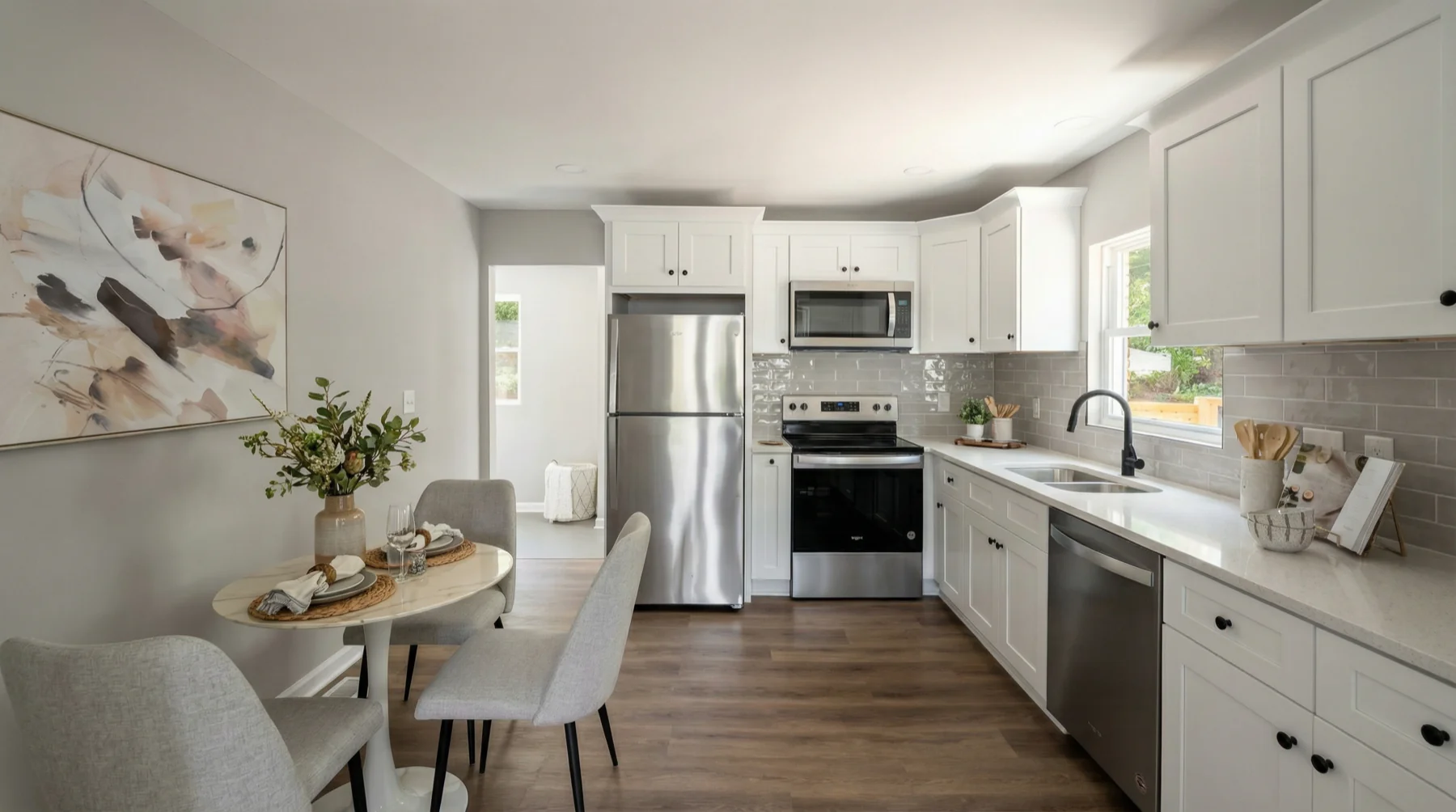
Ask for remnants. Leftover slab pieces run 30% to 70% less than a full slab, according to Slabwise. They fit vanities, small islands and short runs.
They’re rarely advertised, so ask your fabricator or stone yard. A remnant is often enough for the vanity in a bathroom remodel.
-
Pick tier 1 over tier 3. Tiers price the rarity of the color, not how long the stone lasts.
-
See the lookalikes next to the original. Taj-style quartz, porcelain or another cream quartzite may be all the Taj Mahal you need.
-
Keep a straight edge. An eased or square edge usually comes included. Fancy profiles add $10 to $40 per linear foot.
-
Keep the sink where it is. Every cutout costs $100 to $200, and moving the sink also means moving the water and drain lines.
-
Mix materials. The premium stone on the island, a lower-cost one on the perimeter.
-
Tile the backsplash. A full-height slab backsplash is billed like more countertop, by the square foot. A backsplash runs $500 to $1,500 installed, depending on size and material, per Fixr.
-
Get three itemized quotes. Material, fabrication, cutouts, edge, delivery, installation and removal of the old tops, each on its own line. A 20% spread between quotes for the same stone is normal, per Slabwise.
If you’re going to save somewhere, save on rarity and decoration. The stone underneath does the same job.
Where people overspend (and where they shouldn’t save)
Most overspending goes to what you notice on day one: a rarer color, a fancier edge, a slab backsplash.
Most regret comes from what you can’t see: what holds the stone up and who connects it. This is the part we don’t cut corners on.
- 3 cm thickness in the kitchen. A 2 cm slab saves only $200 to $500 on a whole kitchen and needs a plywood base underneath, per Slabwise. Not worth it.
- Approving the seam layout before anyone cuts. Ask to see where every seam falls on the slab. With veined stone like Taj Mahal, that also decides how the veins line up.
- Level, solid cabinets. New stone on cabinets that rock or sit out of level can crack. Heavy stone sometimes needs a few hundred dollars of reinforcement, and that money is well spent.
- A dishwasher bracket under stone. You can’t screw a dishwasher into granite, quartz or quartzite, so it needs a side-mount bracket.
- The finish in writing. Polished, honed or leathered, agreed on paper and seen on the full slab, not only on a small sample. Altering a quartz finish after install can void the manufacturer’s warranty.
- A licensed plumber for the reconnection. The sink, faucet and dishwasher go back in after the stone. We schedule that visit so your kitchen isn’t out of service longer than it needs to be.
From template to install: how long countertop installation takes
The installation itself usually takes one day. The wait is fabrication: about 10 to 14 days from templating to install, and 3 to 4 weeks in busy months, per Slabwise. Here’s the order that keeps it on schedule:
- Cabinets set, level and secured. Nothing gets measured before this.
- Sink, faucet and cooktop chosen. The fabricator needs them to cut the openings.
- Templating. The countertop is measured on the installed cabinets.
- Fabrication. About two weeks. Some quartzites take longer to source.
- Installation. One day.
- Reconnection, then backsplash. A licensed plumber reconnects the sink and dishwasher, and the tile backsplash goes on after the tops are in.
If the cabinets run late, every step after them moves.
We started in 2019 with small repairs, and most of our clients called us first for something small.
As they trusted us with full kitchens, we learned to set the order of every trade before demo day: cabinets, template, fabricator, plumber. Now that sequence is part of every kitchen plan.
Planning a kitchen remodel in South Charlotte?
If new countertops are part of a bigger kitchen job, we’ll walk the kitchen with you, check the cabinets and tell you where your money goes furthest, whether that’s Taj Mahal on the island or granite all around.
See how we handle kitchen remodeling, or browse finished kitchens in our project gallery.
Remodeling estimates are done in person. Call or text (980) 391-6833, or request your estimate online.
iFIXX is insured, and the owner answers directly. We work in Ballantyne, Matthews, Mint Hill, Pineville, Waxhaw and Fort Mill, SC.
Frequently Asked Questions About Countertop Materials
How much does Taj Mahal quartzite cost in Charlotte?
Quartzite runs about $70 to $130 per square foot installed in the Charlotte area, and Taj Mahal sits in the upper part of that range because it is the name everyone asks for. For a 40 square foot kitchen, quartzite in general comes to roughly $2,800 to $5,200 before cutouts, edges and the backsplash, and Taj Mahal lands in the upper half.
What looks like Taj Mahal quartzite but costs less?
Quartz designs made to look like Taj Mahal, porcelain slabs with the same cream and gold veining, and less famous quartzites in the same color family. A Taj Mahal remnant also works for a vanity or a small island. Compare each one next to the real slab before you decide.
What is cheaper, quartz or granite?
Tier 1 granite is usually cheaper. In Charlotte it runs about $45 to $65 per square foot installed, against $55 to $80 for entry-level quartz. Since August 15, 2026, quartz from most countries also pays a 25% tariff, and granite and other natural stone are excluded from it.
What is the best countertop material for the money?
For most full kitchen remodels, tier 1 granite: natural stone that lasts 30 years or more at about $45 to $65 per square foot installed in Charlotte. Entry-level quartz is the pick if you never want to seal anything. Modern laminate is the pick when the budget comes first.
How much should I budget for countertops?
For about 40 square feet in Charlotte, plan on $1,800 to $2,600 for tier 1 granite, $2,200 to $3,200 for entry-level quartz or $2,800 to $5,200 for quartzite. On top of that, budget $100 to $200 per sink or cooktop cutout, any edge upgrade, the backsplash and a licensed plumber to reconnect the sink.
What is the difference between quartz and quartzite?
Quartz is engineered stone: ground quartz bound with resin and made into slabs with an even color. Quartzite is a natural stone cut from a quarry. It is very hard, takes heat better than quartz, needs sealing every 1 to 2 years and usually costs more.
Can I put hot pans on quartz?
Use a trivet. Quartz can scorch from around 300°F, and a burn mark on quartz is hard to repair. Slow cookers, electric skillets and anything else that stays hot for a long time should sit on a trivet or a board too.
Does granite need to be sealed?
Yes, most granite does. Reseal about once a year, or sooner if a few drops of water soak in and darken the stone instead of beading up. A penetrating sealer costs about $15 to $25 and takes around 20 minutes to apply.
Are granite remnants worth it?
Yes, for small pieces. Remnants run 30% to 70% less than a full slab and work well for bathroom vanities, small islands and short runs. You cannot change the size, and they are rarely advertised, so ask your fabricator or stone yard what they have.
How long does countertop installation take?
The installation itself takes about one day. From templating to install, expect about two weeks while the stone is fabricated, and 3 to 4 weeks in busy months. The cabinets have to be set and level before templating, so a cabinet delay pushes everything back.
Need Help With Your Home?
Our team of experts is ready to help with any repair or remodeling project.
Our Services
Need help with a project? We offer expert repair and remodeling services throughout Charlotte.